
geom_point_glow() is a version of ggplot2::geom_point()
that adds a glow (radial gradient) behind each point.
Usage
geom_point_glow(
  mapping = NULL,
  data = NULL,
  stat = "identity",
  position = "identity",
  ...,
  glow_alpha = 0.5,
  glow_colour = NA,
  glow_size = NA,
  na.rm = FALSE,
  show.legend = NA,
  inherit.aes = TRUE
)
Arguments
- mapping
Set of aesthetic mappings created by
aes(). If specified andinherit.aes = TRUE(the default), it is combined with the default mapping at the top level of the plot. You must supplymappingif there is no plot mapping.- data
The data to be displayed in this layer. There are three options:
If
NULL, the default, the data is inherited from the plot data as specified in the call toggplot().A
data.frame, or other object, will override the plot data. All objects will be fortified to produce a data frame. Seefortify()for which variables will be created.A
functionwill be called with a single argument, the plot data. The return value must be adata.frame, and will be used as the layer data. Afunctioncan be created from aformula(e.g.~ head(.x, 10)).- stat
The statistical transformation to use on the data for this layer. When using a
geom_*()function to construct a layer, thestatargument can be used to override the default coupling between geoms and stats. Thestatargument accepts the following:A
Statggproto subclass, for exampleStatCount.A string naming the stat. To give the stat as a string, strip the function name of the
stat_prefix. For example, to usestat_count(), give the stat as"count".For more information and other ways to specify the stat, see the layer stat documentation.
- position
A position adjustment to use on the data for this layer. This can be used in various ways, including to prevent overplotting and improving the display. The
positionargument accepts the following:The result of calling a position function, such as
position_jitter(). This method allows for passing extra arguments to the position.A string naming the position adjustment. To give the position as a string, strip the function name of the
position_prefix. For example, to useposition_jitter(), give the position as"jitter".For more information and other ways to specify the position, see the layer position documentation.
- ...
Other arguments passed on to
layer()'sparamsargument. These arguments broadly fall into one of 4 categories below. Notably, further arguments to thepositionargument, or aesthetics that are required can not be passed through.... Unknown arguments that are not part of the 4 categories below are ignored.Static aesthetics that are not mapped to a scale, but are at a fixed value and apply to the layer as a whole. For example,
colour = "red"orlinewidth = 3. The geom's documentation has an Aesthetics section that lists the available options. The 'required' aesthetics cannot be passed on to theparams. Please note that while passing unmapped aesthetics as vectors is technically possible, the order and required length is not guaranteed to be parallel to the input data.When constructing a layer using a
stat_*()function, the...argument can be used to pass on parameters to thegeompart of the layer. An example of this isstat_density(geom = "area", outline.type = "both"). The geom's documentation lists which parameters it can accept.Inversely, when constructing a layer using a
geom_*()function, the...argument can be used to pass on parameters to thestatpart of the layer. An example of this isgeom_area(stat = "density", adjust = 0.5). The stat's documentation lists which parameters it can accept.The
key_glyphargument oflayer()may also be passed on through.... This can be one of the functions described as key glyphs, to change the display of the layer in the legend.
- glow_alpha
Transparency of the glow between 0 (fully transparent) and 1 (fully opaque). Defaults to
0.5. Either a scalar or a numeric vector whose length matches the number of points.- glow_colour
Colour of the glow. If
NA(default), it inherits the colour of the point itself. Either a scalar colour or a character vector whose length matches the number of points.- glow_size
Glow radius in
ggplot2size units (same scale as thesizeaesthetic inggplot2::geom_point()). IfNA(default), the glow is rendered at nine times the point'ssize. Either a scalar or a numeric vector whose length matches the number of points.For the halo to be visible,
glow_sizemust exceed the point'ssize– otherwise the point grob (drawn on top) fully covers the glow. If this happens the geom emits a one-shot informational message at draw time pointing you at the fix (enlarge the glow or shrink the point). See examples.- na.rm
If
FALSE, the default, missing values are removed with a warning. IfTRUE, missing values are silently removed.- show.legend
logical. Should this layer be included in the legends?
NA, the default, includes if any aesthetics are mapped.FALSEnever includes, andTRUEalways includes. It can also be a named logical vector to finely select the aesthetics to display. To include legend keys for all levels, even when no data exists, useTRUE. IfNA, all levels are shown in legend, but unobserved levels are omitted.- inherit.aes
If
FALSE, overrides the default aesthetics, rather than combining with them. This is most useful for helper functions that define both data and aesthetics and shouldn't inherit behaviour from the default plot specification, e.g.annotation_borders().
Value
A ggplot2::layer() object that can be added to a ggplot2::ggplot().
Coordinate systems
geom_point_glow() works in all coordinate systems. The glow effect
remains point-centric and circular in device space, even in non-linear
coordinates like ggplot2::coord_polar().
References
Murrell, P. (2022). "Vectorised Pattern Fills in R Graphics." Technical Report 2022-01, Department of Statistics, The University of Auckland. Version 1. https://www.stat.auckland.ac.nz/~paul/Reports/GraphicsEngine/vecpat/vecpat.html
Aesthetics
geom_point_glow() understands the following aesthetics. Required aesthetics are displayed in bold and defaults are displayed for optional aesthetics:
| • | x | |
| • | y | |
| • | alpha | → NA |
| • | colour | → via theme() |
| • | fill | → via theme() |
| • | group | → inferred |
| • | shape | → via theme() |
| • | size | → via theme() |
| • | stroke | → via theme() |
Learn more about setting these aesthetics in vignette("ggplot2-specs").
Examples
library(ggplot2)
# Tiny dataset on purpose: each glow point becomes its own
# `grid::radialGradient` pattern, and the example runner accumulates
# patterns from every package example into a single pdf() device. On
# large pdf runs that pattern cache can trigger an upstream R bug at
# `dev.off()` -- unrelated to your real plots.
df <- head(mtcars, 10)
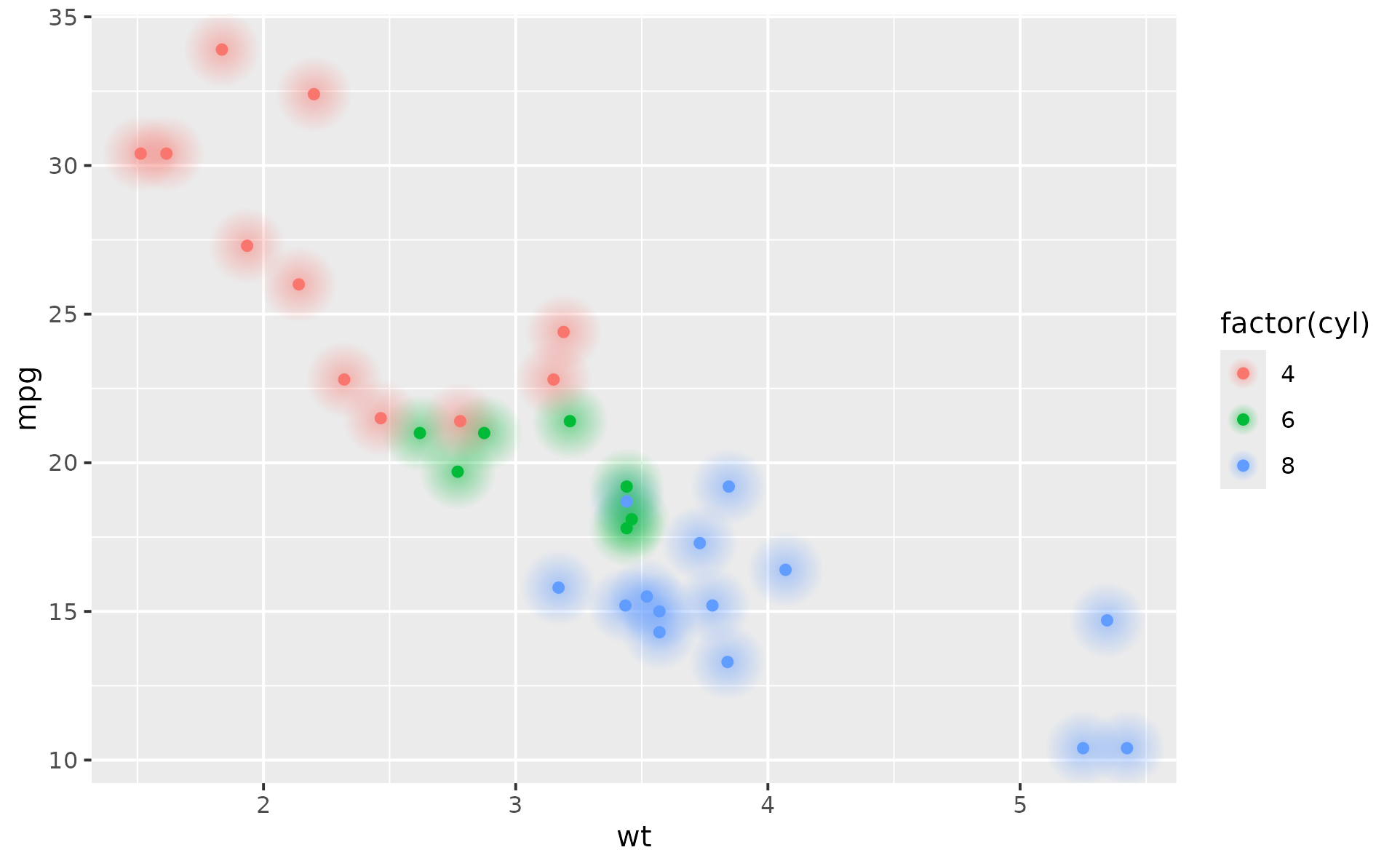
# Basic usage -- the default glow is 9x the point's `size` aesthetic,
# so it's always visibly larger than the point itself.
ggplot(df, aes(wt, mpg, colour = factor(cyl))) +
geom_point_glow()
 # \donttest{
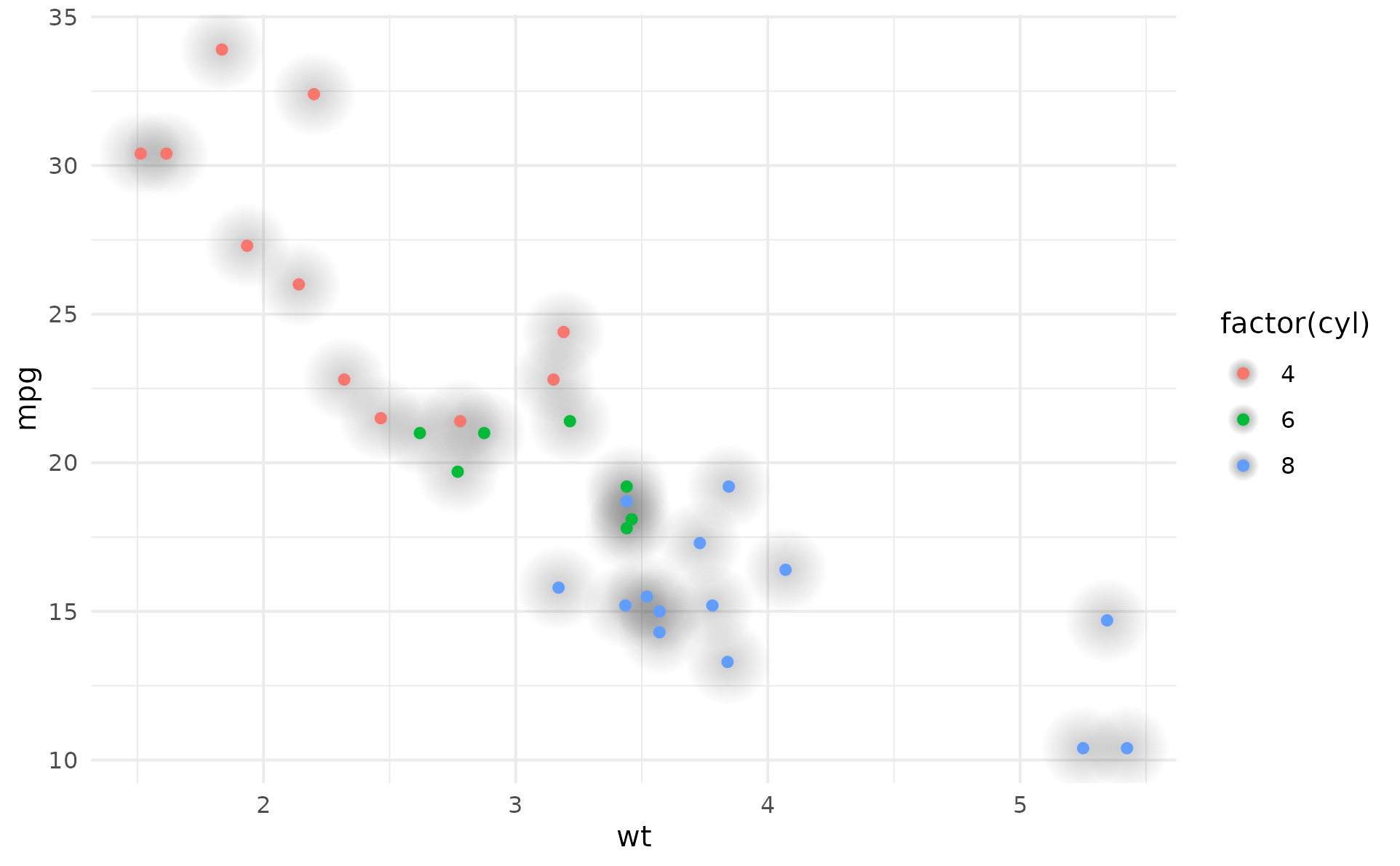
# Customising the glow: fixed values applied to every point, while
# point colour is set to transparent
ggplot(df, aes(wt, mpg)) +
geom_point_glow(
colour = "transparent",
glow_colour = "tomato",
glow_alpha = .75,
glow_size = 20
)
# \donttest{
# Customising the glow: fixed values applied to every point, while
# point colour is set to transparent
ggplot(df, aes(wt, mpg)) +
geom_point_glow(
colour = "transparent",
glow_colour = "tomato",
glow_alpha = .75,
glow_size = 20
)
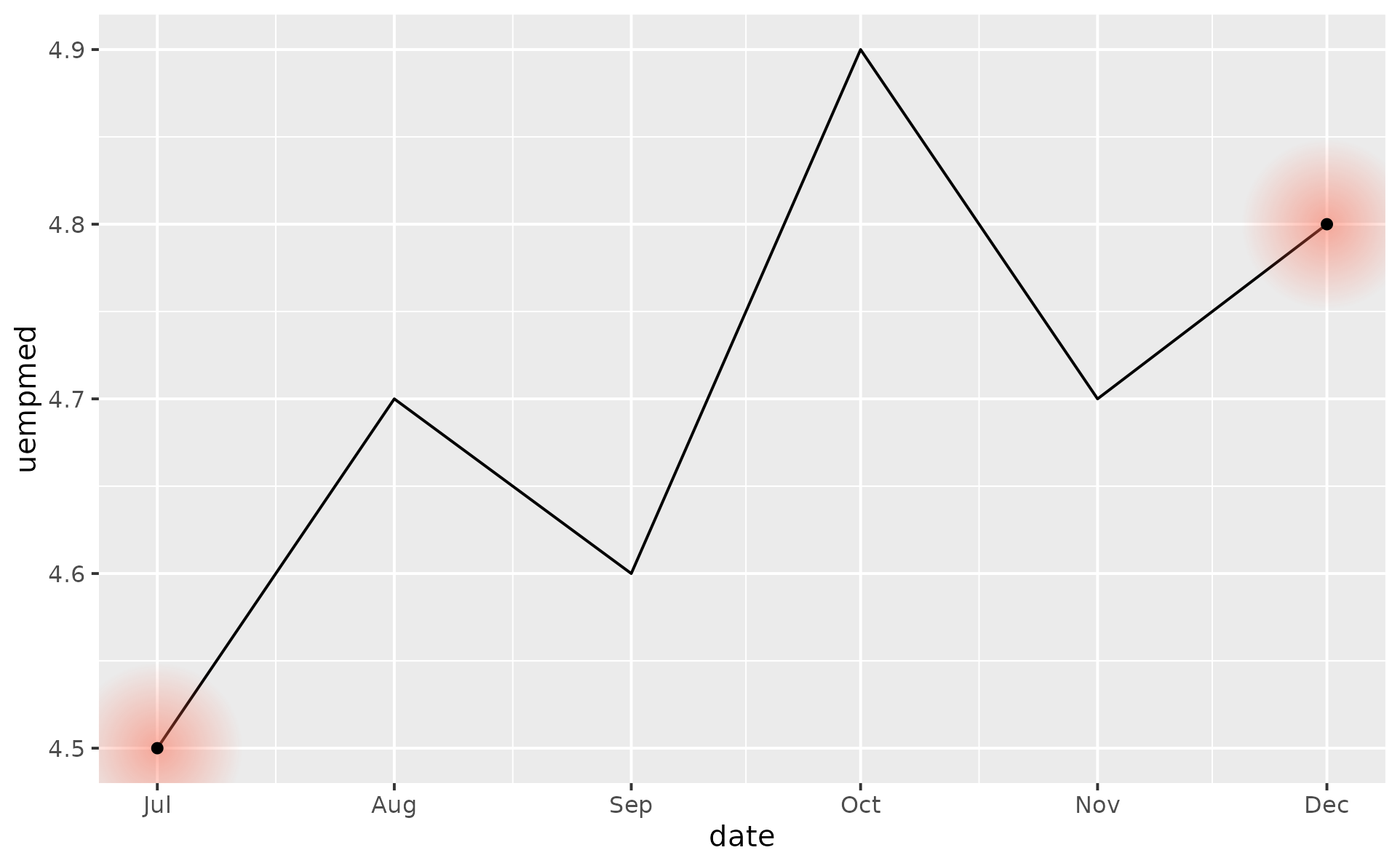
 # Per-point glow: pass a length-N vector for `glow_colour`, `glow_alpha`,
# or `glow_size`.
ggplot(df, aes(wt, mpg)) +
geom_point_glow(glow_colour = rainbow(nrow(df)), glow_size = 15)
# Per-point glow: pass a length-N vector for `glow_colour`, `glow_alpha`,
# or `glow_size`.
ggplot(df, aes(wt, mpg)) +
geom_point_glow(glow_colour = rainbow(nrow(df)), glow_size = 15)
 # Use the Geom with another Stat to glow only specific observations:
ggplot(head(economics), aes(date, uempmed)) +
geom_line() +
stat_pointless(
geom = "PointGlow",
glow_colour = "tomato",
glow_size = 10,
location = c("first", "last")
)
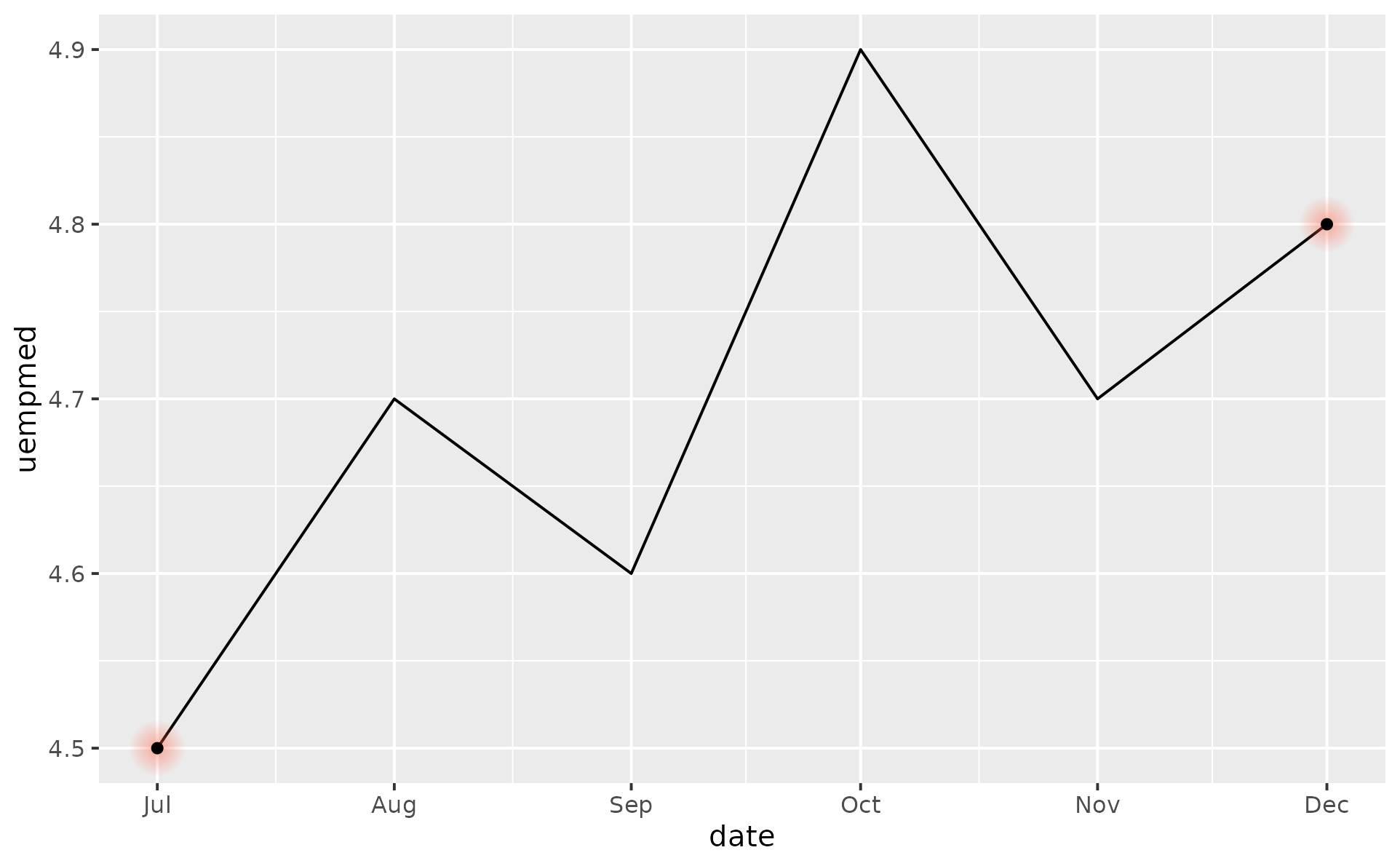
# Use the Geom with another Stat to glow only specific observations:
ggplot(head(economics), aes(date, uempmed)) +
geom_line() +
stat_pointless(
geom = "PointGlow",
glow_colour = "tomato",
glow_size = 10,
location = c("first", "last")
)
 # }
# }